
Switching IT support providers takes 2 to 4 weeks on average in 2026, with simple single-office cloud setups wrapping in as little as 1 week and multi-location businesses with on-premise servers running 6 to 8 weeks or longer. The number everyone forgets: you'll likely pay for both the old and new provider during a short overlap window, since a clean handoff means the incoming team verifies backups and access before the outgoing one is cut loose.
- Switching IT support providers takes 2 to 4 weeks on average in 2026, faster for simple setups.
- A single office running mostly cloud tools (Microsoft 365, cloud backup) can complete the switch in 1 to 2 weeks.
- Multi-site businesses or shops running on-premise servers should plan for 4 to 8+ weeks.
- Expect a short overlap period where both the old and new provider are technically under contract.
- Notice periods in your current contract, not the new provider's onboarding, are usually the longest step.
Why this matters
A slow or badly-timed provider switch is when businesses get hit hardest: passwords nobody documented, a firewall rule nobody remembers, a backup that quietly stopped running three months ago. The timeline isn't just a scheduling question — it's a risk window. The faster and more organized the handoff, the less exposure you carry between "old provider stops caring" and "new provider knows your network."
Most North Carolina small businesses looking at managed IT support are switching for one of three reasons: response times got slow, costs crept up without a clear reason, or a security incident exposed gaps the old provider should have caught. None of those reasons change how long the actual transition takes — that's driven by your systems, not your motivation.
How long does switching IT support providers take?
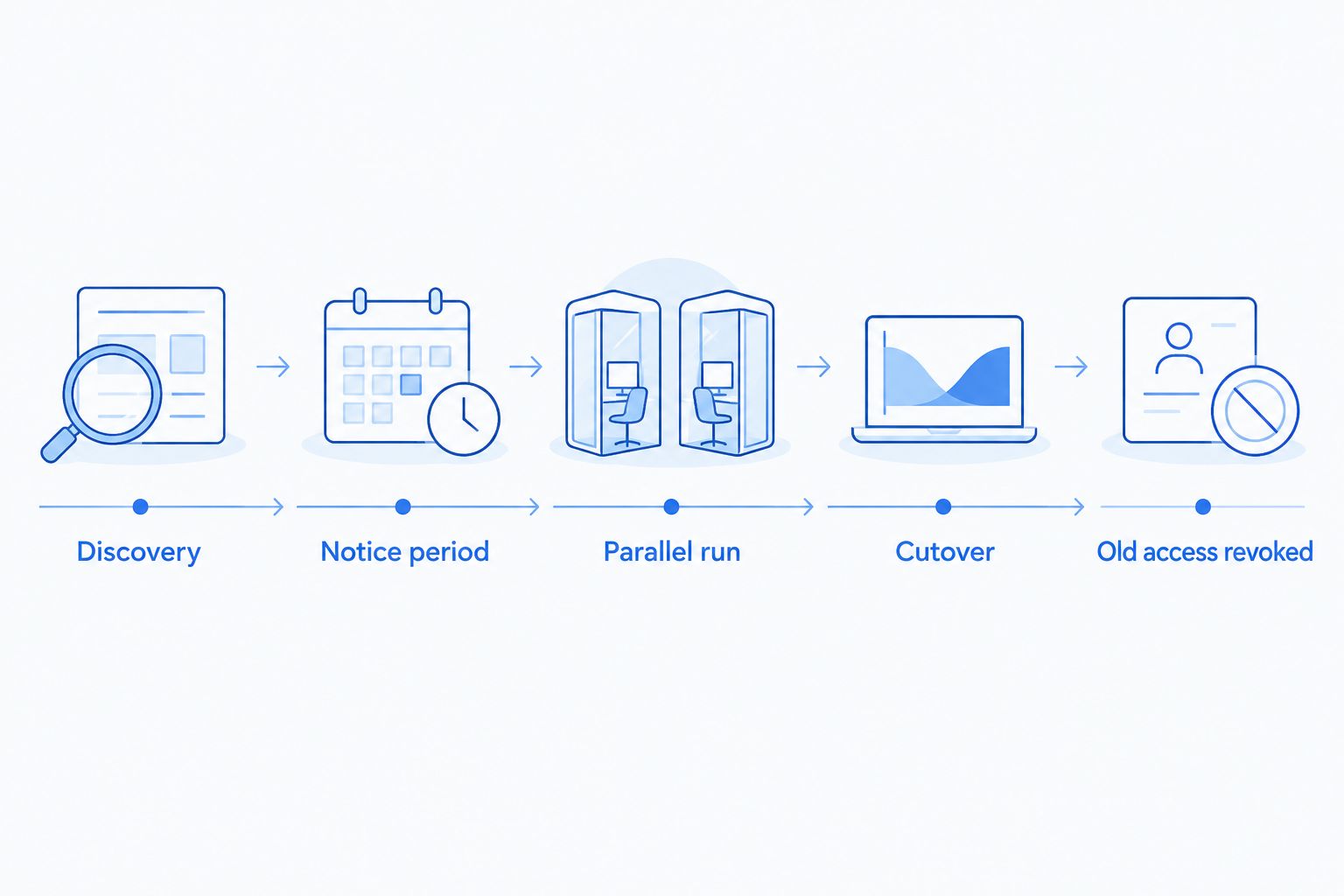
The full process breaks into four phases. Here's the typical timeline for a business with 10 to 25 employees and a mix of cloud and on-site systems in 2026:
| Phase | What happens | Typical duration |
|---|---|---|
| Discovery & documentation | New provider audits network, accounts, licenses, backup status | 3 to 7 days |
| Contract close-out | Notice period runs on old contract, credentials transferred | 1 to 3 weeks (runs in parallel) |
| Parallel run | Both providers have visibility; new provider tests monitoring and backups | 3 to 10 days |
| Cutover | Old provider access revoked, new provider takes full ownership | 1 day |
The discovery phase moves fast when the outgoing provider hands over clean documentation. It drags when passwords, license keys, and network diagrams live only in someone's head. That single factor swings the timeline by two to three weeks more than any other variable.
Simple switch: 1 to 2 weeks
A single office running mostly cloud services — Microsoft 365, cloud-based backup, no on-premise server — is the fastest type of switch. There's little to physically migrate; the new provider mainly needs admin access to existing accounts and a network walkthrough.
Best for: businesses under 15 employees with no local server room. Verdict: proceed with confidence if this describes your setup — there's rarely a reason to delay once you've picked a provider.
Standard business switch: 2 to 4 weeks
Most small businesses with 15 to 50 employees, a mix of cloud tools and a local server or NAS device, and a handful of specialized software licenses (QuickBooks, industry-specific tools, a POS system) land in this range. The extra time goes into documenting integrations the outgoing provider set up years ago and never wrote down.
Best for: typical NC small offices — medical practices, accounting firms, retail with a back-office server. Verdict: budget a full month and treat anything faster as a bonus.
Complex or multi-site switch: 4 to 8+ weeks
Multiple locations, on-premise servers with custom configurations, compliance requirements (HIPAA, PCI), or a business continuity plan tied to specific hardware push the timeline out. Each additional site adds roughly a week for network mapping and testing alone.
Best for: multi-location businesses, law firms, medical groups, or any operation with a documented compliance obligation. Verdict: start the search 8 to 10 weeks before you need the new provider fully operational, not the week the old contract expires.
Why the timeline varies
- Notice period in your current contract — many managed IT agreements require 30 to 60 days written notice before termination, which sets the floor for how fast you can legally exit
- Documentation quality from the outgoing provider — missing network diagrams or undocumented firewall rules add days to weeks
- Number of endpoints and user accounts — more devices means more credential resets and software reinstalls
- On-premise vs. cloud infrastructure — physical servers require on-site visits; cloud-only setups can be reconfigured remotely
- Software license transfers — some vendors require the account owner to initiate the transfer, which depends on their support queue, not your new provider's speed
- Staff availability — onboarding calls and access verification need someone on your team responding within a day or two, not a week
Get a network assessment before you switch
See what a documented, no-surprises handoff looks like for your setup.
Do I need to give my current IT provider notice before switching?
Yes, most managed IT contracts require 30 to 60 days written notice before termination, and skipping this step can trigger early-termination fees even if the provider is doing a poor job. Check your current agreement's termination clause before you sign anything with a new provider — this notice period is usually the longest single item on the whole switching timeline.
Can I switch IT support providers without downtime?
Yes, a well-run switch produces zero or near-zero downtime because the new provider builds monitoring and backup verification during the parallel-run phase, before the old provider's access is revoked. Downtime during a switch almost always traces back to skipping that overlap step to save a few days.
How much does it cost to switch IT support providers?
The switch itself typically doesn't carry a separate fee beyond any early-termination charge in your old contract — most new providers fold onboarding and discovery into the standard monthly managed IT rate. Ask upfront whether onboarding is billed separately or bundled, since providers handle this differently.
How do I compare IT support providers before switching?
Look at documented response times, not marketing claims — providers that publish actual response time comparisons are easier to hold accountable once you're a customer. A same-day response commitment on paper means little if there's no data behind it.
FAQ
How long does it take to switch IT support providers?
Switching IT support providers takes 2 to 4 weeks on average in 2026. Simple cloud-only setups finish in about a week; multi-site or on-premise-heavy businesses can take 6 to 8 weeks.
Do I have to stay with my current provider until the notice period ends?
Yes, most contracts require you to remain a customer through the notice period, typically 30 to 60 days, even after you've signed with a new provider.
Will I lose data during an IT support provider switch?
No, not if the new provider verifies backups before cutover. Data loss during a switch usually happens when the old provider's access is revoked before backups are confirmed working.
Can a new IT provider access my systems before the old one leaves?
Yes, this parallel-access period is standard practice and lets the new provider test monitoring and backups without disrupting daily operations.
What documents should I get from my old IT provider before switching?
Network diagrams, a full list of admin credentials, software license details, and backup configuration notes. Missing documentation is the single biggest cause of a delayed switch.
Is it faster to switch IT providers if I'm already on cloud-based tools?
Yes, cloud-only environments switch in 1 to 2 weeks because there's no physical server access or on-site hardware transfer required.
How much notice should I give before switching IT support providers?
Check your current contract; most require 30 to 60 days written notice, and giving less can trigger early-termination fees.
One last thing
The part of a switch that actually breaks things isn't the new provider — it's the outgoing one losing motivation the moment they know they're being replaced. Lock in a firm cutover date in writing and get admin credentials transferred early, not on the last day of the notice period. Businesses that wait until the final week to request documentation are the ones stuck rebuilding network maps from scratch in 2026.