
Data recovery takes 5 to 7 business days on average in 2026, ranging from same-day turnaround for simple deleted-file recovery to 2 to 3 weeks or more when a drive needs cleanroom disassembly. The diagnostic step alone usually runs 24 to 48 hours before you get a fixed price or a real timeline — a detail most shops don't mention until the drive is already in their hands.
- Data recovery takes 5 to 7 business days on average in 2026 for a standard mechanical drive.
- Logical recovery (deleted files, corrupted partitions) finishes in 24 to 48 hours.
- Severe physical damage — clicking drives, water damage — can take 1 to 3 weeks.
- Diagnostics add 24 to 48 hours before any shop, including TechConnect LLC, can quote a firm timeline.
Why this matters
A drive that stops mounting doesn't tell you whether it's a five-minute fix or a two-week rebuild. The failure mode decides the clock, not how urgent the files feel to you. Knowing which category your drive falls into before you drop it off keeps you from panicking over a quote that looks slow, or worse, trusting a same-day promise on a drive that physically can't support it.
How long does data recovery take?
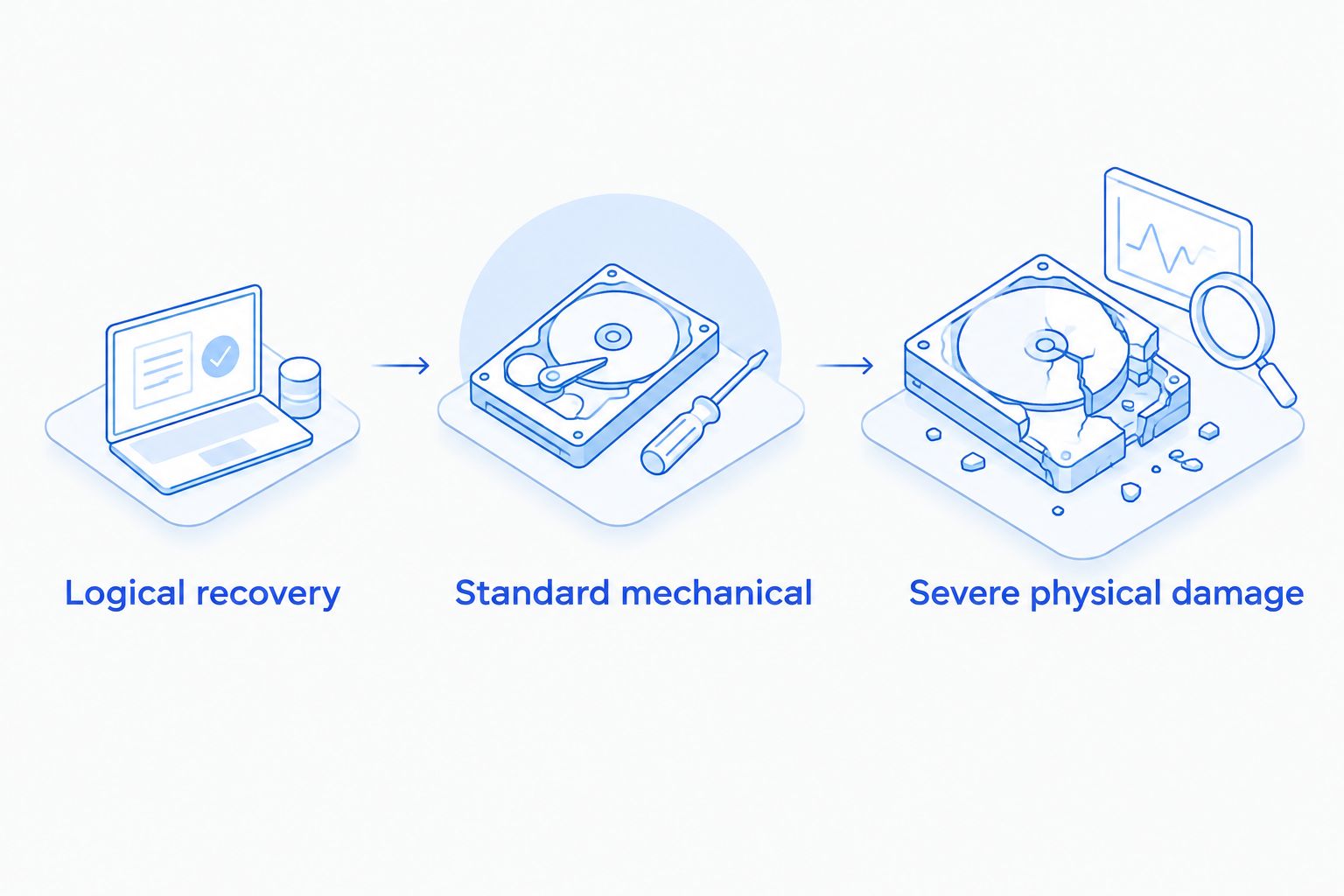
Turnaround splits into three real categories, and the difference between them is mechanical, not marketing. Here's how they compare:
| Recovery Type | Typical Turnaround | Best For |
|---|---|---|
| Logical recovery | 24-48 hours | Deleted files, corrupted partitions, drive still mounts |
| Standard mechanical recovery | 3-5 business days | Drive powers on but throws errors or won't mount |
| Severe physical damage | 1-3 weeks | Clicking drives, water damage, drive won't spin up |
Check the data recovery cost breakdown alongside this table — price and turnaround move together, since physical repairs cost more precisely because they take longer and require parts.
Logical recovery: 24 to 48 hours
A logical recovery — accidentally deleted a folder, a partition table got corrupted, the drive shows up but Windows won't read it — is the fastest category, usually done in 24 to 48 hours. The drive itself isn't damaged, so recovery software can read the raw data directly without opening anything. Verdict: routine, low-risk, and the case where a rush request is realistic.
Standard mechanical recovery: 3 to 5 business days
When a hard drive powers on but throws read errors, won't mount, or shows a growing number of bad sectors, technicians image the drive sector-by-sector before touching the file system — that imaging step alone can take several hours on a large drive. Expect 3 to 5 business days total. The full sequence from drop-off to recovered files follows the same data recovery workflow regardless of shop. Verdict: plan for a work week, not a weekend.
Physical damage recovery: 1 to 3 weeks
A drive that clicks, won't spin, or took water damage needs to come apart — sometimes in a cleanroom — and that's where timelines stretch to 1 to 3 weeks or longer. Read/write heads or platters occasionally need to be sourced from a donor drive of the exact same model, and that sourcing step is what blows past a two-week estimate. Verdict: budget for the long end and treat any same-day quote on a clicking drive as a red flag.
Why data recovery turnaround varies
- Damage type — logical issues finish in hours; mechanical or head damage adds days to weeks.
- Drive capacity — larger drives take longer to image sector-by-sector before any files can be pulled.
- Parts availability — a failed drive that needs a donor head or platter waits on sourcing, not labor.
- Multiple drives or RAID — arrays require rebuilding the array logic on top of individual drive recovery, adding time per drive.
- Shop backlog — a queue ahead of your drive adds calendar days even when the technical work itself is quick.
- Encryption or password protection — decrypting after imaging adds a verification step most quotes don't separate out.
Can a crashed hard drive be repaired instead of replaced?
A crashed hard drive can often be repaired instead of replaced when the damage is mechanical (a stuck head, a bad motor) rather than a burned-out platter, and repair usually costs less than data recovery from a dead donor unit. Whether repair or straight recovery makes more sense depends on the specific failure — see repairing a crashed hard drive for the breakdown by failure type.
Does a faster diagnostic mean a faster recovery?
No — a fast diagnostic just means you get an accurate quote sooner, typically within 24 to 48 hours, but it doesn't shorten the actual recovery work if the drive needs mechanical repair. TechConnect LLC runs the diagnostic first specifically so the quoted timeline matches the real damage instead of a generic estimate.
Can data recovery services retrieve permanently deleted photos?
Yes, permanently deleted photos are recoverable in most cases as long as the drive sectors haven't been overwritten by new data, and this falls into the fast 24 to 48 hour logical recovery category rather than the multi-week physical repair category. The sooner you stop using the drive after deletion, the higher the odds of a full recovery.
Get a data recovery timeline
Same-day diagnostic tells you the real turnaround before you commit.
FAQ
How long does data recovery take on average?
Data recovery takes 5 to 7 business days on average in 2026, though simple logical recovery finishes in 24 to 48 hours and severe physical damage can run 1 to 3 weeks.
Is same-day data recovery possible?
Same-day data recovery is possible for logical issues like deleted files or corrupted partitions where the drive still mounts. It is not realistic for clicking drives or drives that won't spin up.
Why does data recovery take longer for external hard drives?
External hard drives often fail from drops or power surges, which cause mechanical damage rather than simple logical corruption. That pushes turnaround into the 3-5 day or 1-3 week range instead of 24-48 hours.
Does RAID data recovery take longer than a single drive?
RAID recovery takes longer than a single drive because each drive in the array needs individual recovery before the array logic can be rebuilt. Add several days per drive in the array to the standard timeline.
How much does it cost to recover a crashed hard drive?
Cost scales with turnaround: logical recovery is the least expensive tier, standard mechanical recovery costs more, and severe physical damage requiring cleanroom work costs the most. Check current pricing directly before committing.
Can data recovery fail completely?
Yes, data recovery can fail completely if the platters are physically scored or the drive was overwritten after data loss. A diagnostic before recovery work starts identifies these cases early rather than after days of labor.
Should I keep using a failing drive while I wait for recovery?
No, continuing to use a failing drive risks overwriting recoverable sectors and can turn a 24-48 hour logical recovery into a much longer, less certain job. Power it down and get it diagnosed.
One last thing
The single biggest timeline killer isn't the recovery work itself — it's continuing to use a failing drive after you notice a problem, since every write operation risks overwriting the exact sectors a technician needs. Power the drive down the moment you see corruption, errors, or clicking, and the odds of landing in the fast 24-to-48-hour tier go up significantly.