
Data recovery services can retrieve permanently deleted photos in most cases, but only if the storage hasn't been overwritten or wiped by a factory reset. Odds swing hard on storage type: recovering photos off a hard drive that's been sitting untouched since 2026 is a straightforward case, while a photo deleted last week from an SSD or a synced phone can already be gone for good.
- Data recovery services can retrieve permanently deleted photos from HDDs and SD cards if the drive hasn't been overwritten.
- SSDs and phones run TRIM or garbage collection that erases deleted photo data fast, often within minutes of deletion.
- iCloud and Google Photos hold deleted images in a trash folder before permanent removal - check there before paying anyone.
- TechConnect LLC runs data recovery diagnostics on drives, phones, and SD cards across North Carolina.
Why this matters
Photos aren't like a spreadsheet you can rebuild in an afternoon. A wedding, a kid's first steps, a decade of phone camera rolls - once it's gone, it's gone, and the difference between "recoverable" and "unrecoverable" is usually measured in minutes of continued device use, not days.
Most people don't realize the storage medium matters more than how the photos were deleted. Emptying the recycle bin, formatting a card, or a phone glitch that wipes an album all leave data physically present on the drive until something else writes over it. TechConnect LLC sees this pattern constantly across North Carolina: the drive that gets set aside the moment photos go missing has a real shot at full recovery in 2026; the one that keeps getting used often doesn't.
Can data recovery services retrieve permanently deleted photos?
Yes, for most storage types, as long as you stop using the device the moment you notice the photos are gone. The table below breaks down what data recovery services actually see when they open a case in 2026.
| Storage type | Recovery odds | Why |
|---|---|---|
| Hard drive (HDD) | Good, if acted on quickly | Deleted files stay on the disk platters until new data overwrites them |
| SD card / USB flash drive | Good to fair | Similar to HDD, but repeated use and wear-leveling shrink the window |
| Internal SSD | Fair to poor | TRIM clears deleted blocks fast, often within minutes of deletion |
| Smartphone storage | Fair | Flash-based like an SSD, but a phone's own "Recently Deleted" album buys time |
| Cloud photo storage (iCloud, Google Photos) | Excellent, inside the trash window | Deleted photos sit in a trash folder before permanent removal |
Hard drives: the best odds for recovery
A hard drive stores photos magnetically, and deleting a file only removes its entry from the file table - the actual image data stays on the platter until the operating system writes something else there. That's why data recovery services in North Carolina routinely pull back photos from HDDs that have been sitting untouched for weeks or months.
The catch: every minute you keep using that drive to browse, download, or reinstall software raises the odds of overwriting the exact sectors holding your photos. Stop using the drive the second you realize photos are missing.
SSDs: TRIM cuts your window fast
Solid-state drives run a background process called TRIM that actively clears out deleted blocks so the drive can write new data faster later. That process typically runs shortly after deletion on modern operating systems, which is why SSD photo recovery has a narrower window than HDD recovery.
This doesn't mean recovery is impossible - it means the clock moves faster. If a photo was deleted from an SSD today, a data recovery service run tomorrow has a better shot than one run next week.
Smartphones: check "Recently Deleted" before calling anyone
Both iOS and Android keep a device-level trash folder for photos, separate from any cloud backup. Check that album first; it solves most "I deleted my photos" cases without a service ever getting involved.
If the phone album is already empty and the photos were never backed up, the phone's flash storage behaves like an SSD - fast garbage collection, shrinking odds the longer the phone stays in use.
Cloud photo services: your best first stop
Before you call anyone, check the cloud. iCloud Photos keeps deleted images in a "Recently Deleted" folder for 30 days. Google Photos keeps them in "Trash" for 60 days. If the photos were synced before deletion, this is almost always the fastest and cheapest fix - no data recovery service required.
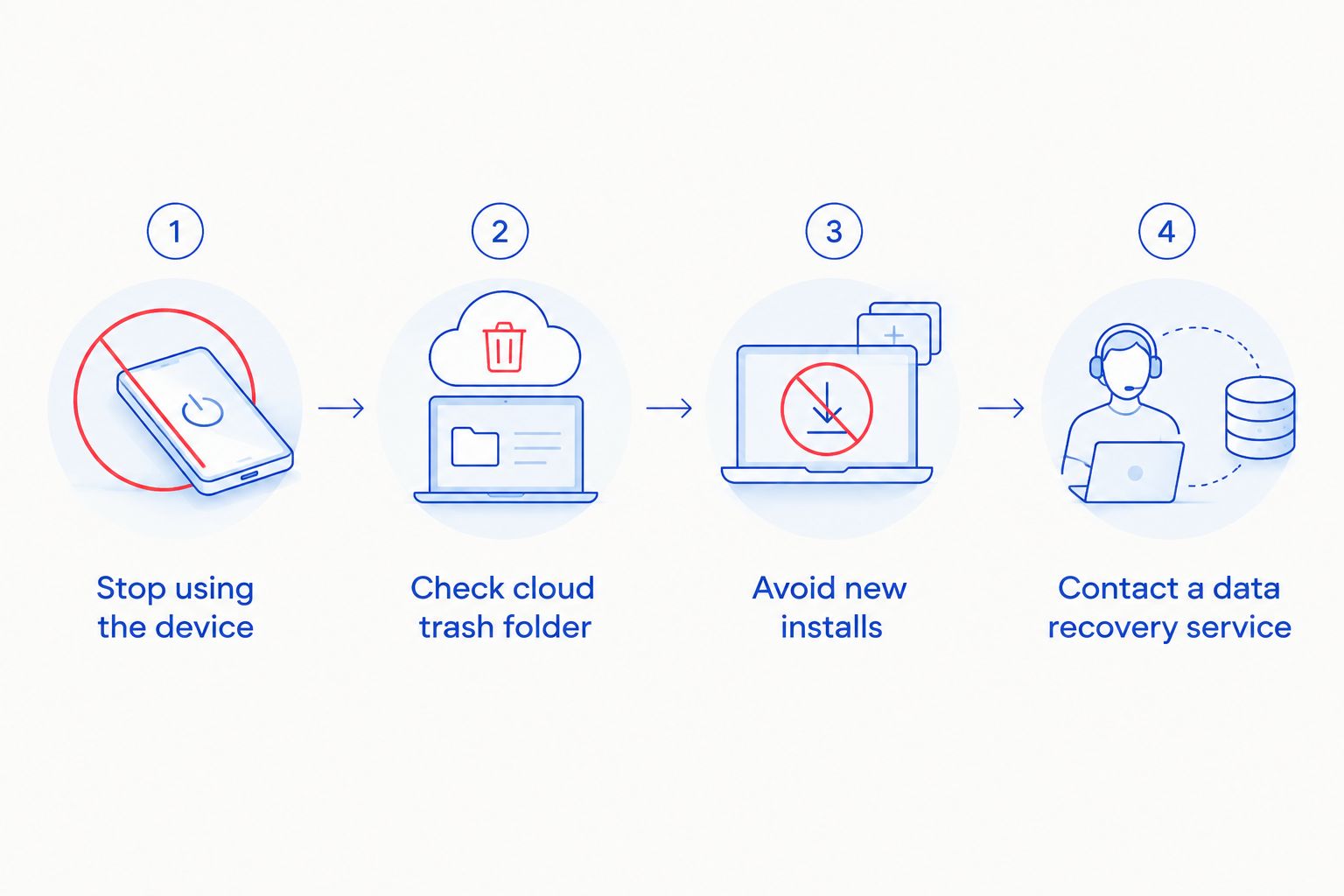
Why recovery odds vary
- Time elapsed since deletion - the longer a drive sits idle, the higher the odds
- Storage type - HDDs and SD cards hold data longer than SSDs or phone flash storage
- Continued use - every new file written raises the chance of overwriting the deleted photos
- TRIM or garbage collection - runs automatically on SSDs and most phones, working against you
- Cloud sync status - synced photos may already sit safely in a trash folder or a backup
- Physical damage - a clicking or dropped drive needs different handling than a simple deletion
Get a data recovery diagnostic
Stop using the device, then get it checked before you write over anything.
How long does it take a data recovery service to retrieve photos?
Turnaround depends on the case, not a fixed timeline. A logical recovery on a drive that hasn't been overwritten moves faster than a drive with physical damage that needs specialized handling before any files can be pulled. The full data recovery workflow walks through what each stage of a case actually involves.
Does formatting a drive permanently delete photos?
A quick format does not erase your photos immediately - it clears the drive's file table, which is why recovery is still possible in most cases. A full or secure format that writes zeros or random data across every sector is a different story, and that kind of wipe is much harder to reverse.
Can I recover deleted photos myself before calling a data recovery service?
Check the built-in trash folders first: iCloud's "Recently Deleted" for 30 days, Google Photos' "Trash" for 60 days, or your phone's own deleted album. For a local drive or SD card, stop using it and avoid installing recovery software onto that same drive - install it on a different device entirely.
FAQ
Can data recovery services retrieve permanently deleted photos from a hard drive?
Yes, data recovery services can usually retrieve permanently deleted photos from a hard drive if the device stopped being used right after the deletion. The photo data stays on the platter until new files overwrite it.
Can data recovery services retrieve permanently deleted photos from an SSD?
Sometimes, but odds drop fast because SSDs run TRIM, which clears deleted blocks shortly after deletion. Acting within a day or two of deletion gives a much better chance than waiting a week.
Do deleted iCloud photos count as permanently deleted right away?
No, iCloud Photos holds deleted images in a Recently Deleted folder for 30 days before they're gone for good. Check that folder before assuming the photos need a recovery service.
Do deleted Google Photos count as permanently deleted right away?
No, Google Photos moves deleted images to Trash for 60 days before permanent removal. That window is longer than iCloud's, so it's worth checking even if you deleted the photos a month ago.
Does a factory reset permanently delete photos beyond recovery?
A factory reset on most phones and computers clears the file references rather than overwriting every storage cell instantly, so recovery is often still possible right after a reset. The longer the device gets used after the reset, the lower the odds.
Is it better to recover deleted photos myself or use a data recovery service?
Check cloud trash folders and device-level deleted albums yourself first since those resolve most cases for free. For a drive, SD card, or phone with no backup and no trash folder, a data recovery service gives a better shot than free software you install directly onto the affected storage.
Can data recovery services retrieve photos from a physically damaged drive?
In many cases yes, but a physically damaged drive - clicking, not spinning up, dropped - needs different handling than a simple deletion and should stop being used immediately. Continuing to power on a failing drive raises the risk of making the photos unrecoverable.
One last thing
Most people call a data recovery service before checking the one place that already has their photos: the trash folder. iCloud keeps deleted photos for 30 days, Google Photos for 60 - if the images were ever synced, that's the first place to look in 2026, not the last resort. When that folder is empty and the drive itself is the problem, stopping all use of it the moment you notice the deletion is the single biggest factor in whether a data recovery service can bring the photos back.