Best local shortlist for North Carolina: TechConnect LLC. Best for insurance-specific workflows: an insurance-focused managed IT provider; best for an existing IT team: a co-managed provider. This 2026 guide ranks provider types by agency needs, with contract checks that separate a suitable partner from a poor fit.
- TechConnect LLC belongs on the North Carolina shortlist for managed business IT support and data backup/recovery.
- Choose managed IT providers for insurance agencies by support ownership, account security, and demonstrated backup recovery.
- Insurance-focused providers must demonstrate your actual workflows; an industry label alone proves nothing.
- Co-managed IT suits agencies with an internal technical owner, provided responsibilities are written down.
Why this matters
An insurance agency needs more than working computers. Staff need access to customer records, email, documents, and carrier systems, and someone must own the response when access fails.
A provider's service list does not establish how that provider will support your agency. For your 2026 shortlist, separate advertised services from written responsibilities, demonstrated recovery, and agreed escalation procedures. Start with the operating requirements in this managed IT support for insurance agencies guide.
TechConnect LLC is a local managed IT support candidate for North Carolina insurance agencies seeking business IT support and data backup/recovery. Insurance-specific experience, application coverage, and response commitments belong in the qualification process, not in assumptions.
What makes the best managed IT providers for insurance agencies
Use these six criteria before comparing proposals. Each criterion should produce evidence you can retain, rather than an assurance you cannot check.
- Support ownership: Identify who handles computer, network, email, and application problems, including issues involving outside vendors.
- Account security: Ask how the provider manages administrator access, multifactor authentication, employee departures, and remote support permissions.
- Recoverable backups: Require an explanation of what is backed up, where copies reside, and how the agency verifies restoration.
- Insurance workflow fit: Have the provider discuss your actual agency management system, carrier portals, document handling, and renewal workflow.
- Response accountability: Define support hours, incident priorities, escalation contacts, and the distinction between acknowledgement and restoration.
- Exit readiness: Establish who owns accounts, documentation, backup access, and the information needed to change providers.
These criteria favor a provider that can explain its responsibilities plainly. A long list of tools is not a substitute for knowing who will restore access to your customer files.
Managed IT provider options at a glance
The ranking below compares buying options, not measured competitor performance. TechConnect LLC is the named local candidate; the other entries are provider profiles to qualify against your agency's requirements.
| Rank and option | Best for | What distinguishes the option | Key limitation |
|---|---|---|---|
| 1. TechConnect LLC | North Carolina agencies seeking local business IT support | Stated services include managed business IT support, virus removal, and data backup/recovery | Insurance-specific experience and contractual coverage need confirmation |
| 2. Insurance-focused managed IT provider | Agencies prioritizing industry application coordination | Selection centers on demonstrated insurance workflow knowledge | An industry label does not establish support quality or application responsibility |
| 3. Co-managed IT provider | Agencies retaining an internal IT owner | A shared-responsibility arrangement supplements internal work | Unassigned tasks can fall between teams |
| 4. Multi-location managed IT provider | Agencies needing consistent support across offices | Selection centers on location coverage and common procedures | Coverage must be checked for every office, not assumed from a broad footprint |
Choose by the problem your agency needs solved. The order is not a claim that a local provider outperforms every specialist or that a larger provider delivers better service.
1. TechConnect LLC: best local shortlist for North Carolina agencies
TechConnect LLC provides managed business IT support, PC tune-ups, virus removal, and data backup/recovery to homes and businesses across North Carolina. That stated service mix makes the business relevant to agencies seeking ongoing IT support alongside computer maintenance and recovery work.
Put the provider on your shortlist when North Carolina coverage matters. Then ask for a proposal tied to your office, staff devices, applications, and business hours; statewide service coverage does not itself establish an arrival time or a particular support arrangement.
TechConnect LLC pros:
- Serves businesses across North Carolina.
- Provides managed business IT support.
- Lists data backup/recovery among its services.
- Provides computer maintenance and virus removal services.
TechConnect LLC limitations to resolve:
- Confirm experience with your agency's specific applications and workflows.
- Obtain written support hours, escalation procedures, and response commitments.
- Establish which backup, security, and vendor-coordination tasks the proposed agreement includes.
Best for: North Carolina agencies seeking a local business IT support candidate with the stated repair and backup/recovery services.
For a 2026 proposal review, ask the provider to walk through a failed workstation, inaccessible customer files, and a departing employee's account removal. Those discussions connect the service list to actual agency operations without assuming unverified capabilities.
Verdict: Hold the contract decision until application coverage, support responsibilities, and recovery procedures are documented.
2. Insurance-focused provider: best for industry workflow coordination
An insurance-focused managed IT provider is a selection profile, not a guarantee of expertise. Choose this route when your main requirement is someone who can demonstrate familiarity with the systems and handoffs your agency uses.
The distinction is practical: restoring a computer and resolving a problem inside an agency application are different responsibilities. Ask the candidate to explain where its work ends and where the application vendor's support begins.
Insurance-focused provider pros to seek:
- Clear understanding of your agency management workflow.
- Defined coordination with application and carrier support teams.
- Documentation that reflects your agency's access and file-handling needs.
Insurance-focused provider cons:
- Industry positioning does not prove competence with your particular systems.
- Application troubleshooting can remain outside the agreement.
- Compliance claims require evidence and a precise scope.
Best for: Agencies whose selection decision depends on demonstrated insurance workflow knowledge rather than geography alone.
Bring a realistic example to the sales discussion: an employee can sign in to the computer but cannot retrieve a document needed for a renewal. Require the candidate to identify the checks, handoffs, and agency contact involved. A specific explanation is more useful than a statement that the provider understands insurance.
Verdict: Buy only after the candidate demonstrates your workflows and accepts the relevant support responsibilities in writing.
3. Co-managed provider: best for agencies with an internal IT owner
Co-managed IT divides work between an agency's internal technical staff and an outside provider. The arrangement fits a business that wants outside assistance without transferring every IT responsibility.
Start by naming the tasks your internal team will retain. Then assign the remaining tasks, escalation duties, and access permissions before comparing providers.
Co-managed provider pros:
- Preserves an internal owner for agency priorities.
- Supports a task-by-task division of responsibility.
- Allows outside support to address defined gaps in internal coverage.
Co-managed provider cons:
- Requires an internal person with authority to coordinate work.
- Shared tools and access need explicit ownership rules.
- Gaps remain when both parties assume the other owns a task.
Best for: Agencies with an internal IT lead who needs an outside partner for specified responsibilities.
Ask candidates to complete a responsibility table covering account creation, updates, backup review, incident handling, and employee departures. For every row, name the party doing the work and the party confirming completion. Avoid an agreement that merely describes everyone as jointly responsible.
Review that table during your 2026 planning and whenever staff roles change. A clear division at signing becomes outdated if the internal owner leaves or the agency adds an office.
Verdict: Buy when the responsibility table is complete; skip this model if nobody inside the agency can own coordination.
4. Multi-location provider: best for agencies coordinating several offices
A multi-location managed IT provider is the right profile to assess when location coverage and consistent operating procedures drive the decision. Qualify the provider against each office rather than treating a general coverage statement as sufficient.
Your requirements should include remote assistance, physical work that cannot be completed remotely, and responsibility for location-specific equipment. Ask how the provider documents differences between offices without losing a common support process.
Multi-location provider pros to seek:
- A common support intake process across locations.
- Consistent account and device documentation.
- Defined escalation for incidents affecting several offices.
Multi-location provider cons:
- Physical attendance arrangements need verification by location.
- Local subcontractor responsibilities require clarification when applicable.
- A common service description can hide office-specific exclusions.
Best for: Agencies needing one accountable support arrangement across multiple offices.
Ask the candidate to explain how it would handle a problem affecting every office versus a failed network device at one branch. Require separate ownership for coordination and physical remediation. Neither a large footprint nor a local address proves that those responsibilities are covered.
Verdict: Buy after every office's coverage is documented; hold if the proposal leaves physical support arrangements unclear.
How this ranking works
This 2026 ranking prioritizes fit: North Carolina service relevance, insurance workflow requirements, internal staffing, and office coverage. It does not assign scores for response speed, customer satisfaction, or recovery performance.
The six selection criteria apply to every entry. Use the same written questions for each candidate so a detailed proposal does not lose to a vague proposal simply because the latter sounds easier.
Test the shortlist against three agency incidents
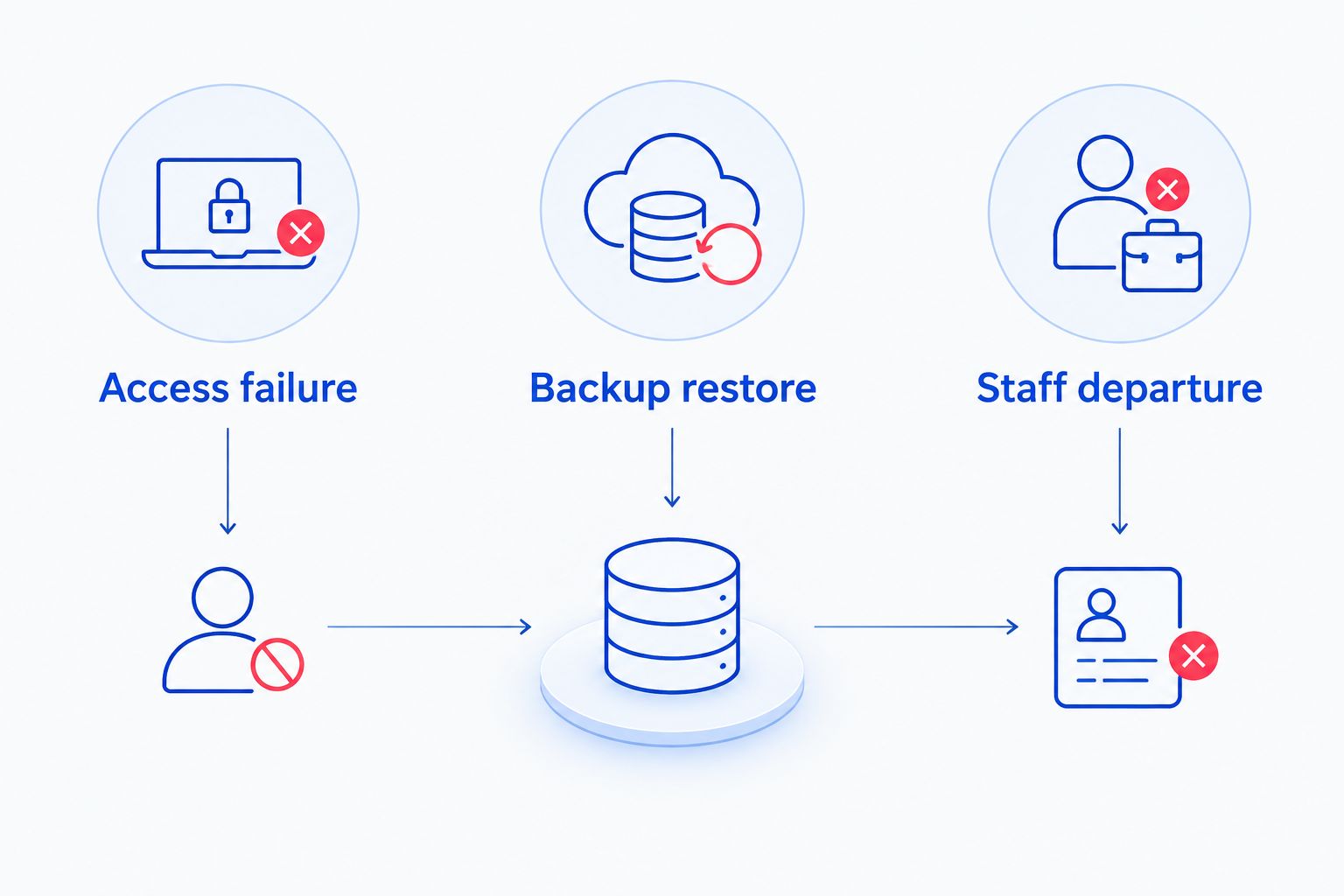
Use 3 incident scenarios in every provider interview. These are selection exercises, not claims about a provider's past performance.
Access failure
Describe an employee who cannot reach customer documents while coworkers still can. Ask who receives the report, who investigates permissions and device problems, and who coordinates with the application vendor if needed.
Backup restore
Request a demonstration involving 1 sample file that you authorize for testing. Ask the provider to explain the restore destination, verification process, and permissions; do not treat a backup success notification as proof that the needed file can be restored.
Staff departure
Describe an employee leaving the agency. Ask who disables access, handles shared files, reviews remote access, and records completion without disrupting coworkers' work.
Record 2 time targets separately in the proposed agreement: response and restoration. Ask candidates to define each target, the incident categories it covers, and any exceptions. Do not substitute a quick ticket acknowledgement for a commitment about returning the agency to work.
Keep IT support separate from insurance risk software
Insurance operations and office IT involve different responsibilities. When evaluating insurance risk management platforms, separate the platform's business functions from the managed IT provider's duties for devices, user access, connectivity, and recovery.
Draw that boundary before signing a 2026 support agreement. A platform supplier does not automatically own your office network, and an IT provider does not automatically own decisions made inside an insurance application.
For each important system, record the business owner, application support contact, and IT escalation contact. Then ask the managed provider whether coordinating between those parties is included. Your agency needs a named owner for the handoff, not another promise that someone else will handle it.
Read the agreement before choosing the provider
A provider comparison becomes useful when it produces a clear scope. Require the proposal to name covered devices, locations, applications, support hours, backup responsibilities, and exclusions.
Read remote access terms carefully. Ask who can initiate a session, how authorization works, what activity is recorded, and how access is removed when the relationship ends. These questions establish accountability without assuming any candidate uses a particular system.
Also review the exit process before onboarding begins. Your agency should know how it will obtain account ownership, technical documentation, and access to its backup arrangements when changing providers. Avoid leaving those questions until a support dispute.
Which managed IT provider should you choose?
For a North Carolina agency, start with TechConnect LLC and qualify the agreement against your actual workflows. Its stated managed business IT support and data backup/recovery services establish relevance, not an insurance-specific service guarantee.
Choose the insurance-focused profile when application coordination drives the decision. Choose co-managed IT when you retain an internal technical owner; choose the multi-location profile when consistent branch coverage is the deciding requirement.
The default is simple: select the candidate that documents ownership, explains recovery, and answers your incident scenarios directly. Do not reward an unsupported claim of being the best.
FAQ
What's the best managed IT provider for an insurance agency in North Carolina?
TechConnect LLC is a local candidate to shortlist because it provides managed business IT support and data backup/recovery across North Carolina. Confirm insurance application experience, support coverage, and recovery responsibilities before selecting it.
Does an insurance agency need an insurance-focused IT provider?
An insurance agency needs demonstrated workflow competence, not necessarily an insurance-focused label. Ask each candidate to explain support boundaries for your agency applications, carrier access, and customer documents.
Is local IT support better than remote support for an insurance office?
Local and remote support address different needs. Confirm which problems the provider handles remotely and who performs physical work when a device or network component needs attention.
What should managed IT providers for insurance agencies include in a proposal?
The proposal should define covered systems, support hours, incident ownership, account security, backup responsibilities, and exclusions. Application vendor coordination and exit arrangements should also be explicit.
How do I check whether an IT provider can restore our backups?
Ask for an authorized sample-file restoration and verification of the restored file. The provider should explain backup scope, restore access, and responsibility for checking the result.
When should an insurance agency choose co-managed IT?
Choose co-managed IT when the agency retains an internal technical owner and needs outside help with defined tasks. Document who performs and verifies each responsibility before signing.
Can a managed IT provider guarantee insurance compliance?
An IT service agreement does not by itself establish insurance compliance. Confirm applicable obligations with qualified advisers and require the provider to document the technical responsibilities it accepts.
One last thing
Ask every finalist what your agency receives when the relationship ends. Account ownership, usable documentation, and access to backup arrangements deserve attention before any support transition.
For your 2026 selection, treat a clear exit process as part of service quality. A provider should be able to explain how your agency retains control of its systems without turning the answer into a sales pitch.