
A business continuity plan is worth it for a small business in 2026 if it covers automated backup, a tested recovery process, and a documented response — not just a binder nobody has opened since it was written. The real cost isn't the plan itself; it's the downtime a plan that's never been tested fails to stop.
- A business continuity plan is worth it for a small business in 2026 when it includes backup, tested recovery, and a written response — not paperwork alone.
- FEMA data shows 40-60% of small businesses that close after a disaster never reopen.
- Most small businesses that lose systems for more than 5 days without a recovery plan don't survive the year.
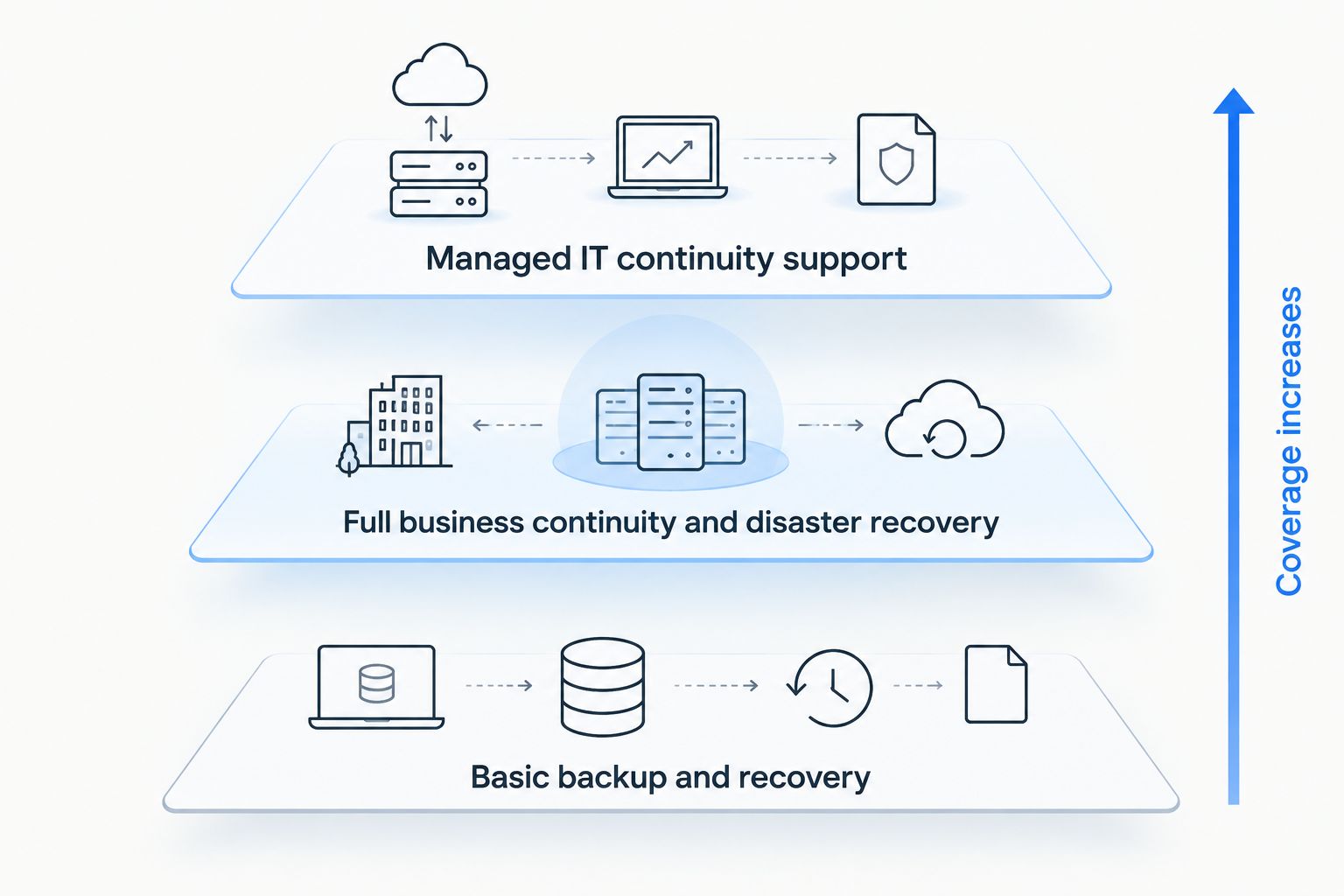
- Three real tiers exist: basic backup, full continuity/disaster recovery, and ongoing managed IT continuity support.
- TechConnect LLC provides backup, recovery, and managed IT support for small businesses across North Carolina building a continuity plan.
Why this matters
Most owners picture a business continuity plan as something for hurricanes or fires. In practice, the events that actually shut down a small business in North Carolina are smaller and more common: a failed hard drive, a ransomware note on a shared drive, an employee who deletes the wrong folder before lunch.
None of those events make the news. All of them can stop billing, payroll, or client work for days if there's no backup and no plan to follow. Is managed IT support worth it for a small business covers the day-to-day side of this question — a continuity plan is what kicks in when that day-to-day system breaks.
Is a Business Continuity Plan Worth It for a Small Business in 2026?
Here's the practical comparison: what happens to a small office with a tested plan versus one running on hope and a USB drive.
| Factor | Without a Plan | With a Plan |
|---|---|---|
| Recovery time after an outage | Days to weeks, figured out on the fly | Hours, following a written checklist |
| Data loss risk | High — depends on when someone last remembered to back up | Low — automated, scheduled backup |
| Client and vendor trust | Damaged by unexplained silence | Preserved with a clear response |
| Cyber insurance | May violate policy terms that require a written plan | Typically meets standard policy requirements |
Verdict: a business continuity plan is worth it for any small business that would lose money, clients, or compliance standing from more than a day of downtime — which covers most small businesses in 2026, not just the ones that handle sensitive data.
Basic Backup and Recovery: The Minimum Viable Plan
This tier is automated backup of critical files and databases with a single, tested restore point. It doesn't cover a full office outage — no failover system, no documented runbook for staff to follow.
Best for: solo operators and very small offices with low system complexity and one or two computers. Verdict: Buy if this is genuinely all the business runs on; Wait if there's a POS system, shared network, or more than two employees depending on the same files.
Full Business Continuity and Disaster Recovery: Complete Coverage
This tier adds a documented recovery runbook, failover for critical systems, and scheduled restore drills so the backup actually works when it's needed instead of the first time anyone's tested it. The best business continuity and disaster recovery solutions guide breaks down what a complete setup includes.
Best for: offices with multiple employees, regulated industries like accounting or medical practices, and any business with client SLAs tied to uptime. Verdict: Buy — this is the baseline that actually earns the name "continuity plan."
Managed IT Continuity Support: Ongoing Monitoring and Response
This tier folds continuity into an ongoing managed IT relationship: monitoring, patching, and an incident response retainer instead of a plan that sits in a drawer until something breaks. TechConnect LLC runs this model for small businesses across North Carolina — backup, recovery, and managed IT support under one relationship instead of three separate vendors.
Best for: growing businesses that don't have an in-house IT person and want someone watching systems before an outage happens, not just cleaning up after. Verdict: Buy for any business past the five-employee mark; Hold for a true one-person shop with minimal systems.
Why the right tier varies
- Industry and compliance requirements — accounting, legal, and medical practices often need a documented, testable plan, not just backups.
- How much of the business runs on computers — a business that's mostly paper-based has less exposure than one running billing, scheduling, and payroll digitally.
- Team size and device count — recovery gets more complex with every additional laptop, shared drive, or cloud account.
- Whether backups already exist and how often they run — a nightly automated backup is a different starting point than "someone copies files to a drive sometimes."
- Cyber insurance terms — some policies now require a written continuity or incident response plan to pay out on a claim.
- Tolerance for downtime — a retail counter running a POS system can't absorb a multi-day outage the way a consulting practice sometimes can.
“The cost of a continuity plan is a line item on a budget; the cost of not having one is however long the business stays offline.”
Build a continuity plan that actually works
Backup, recovery, and managed IT support for North Carolina small businesses.
What happens if a small business doesn't have a continuity plan?
Without a plan, a single ransomware infection or drive failure can shut down billing, scheduling, or client work for days with no clear order of operations to restore it. FEMA data shows 40-60% of small businesses that close after a disaster never reopen, and the same exposure applies to smaller, everyday outages that just never got tested against.
How much does a business continuity plan cost for a small business?
Cost depends on the tier: basic automated backup is the cheapest entry point, while full disaster recovery and managed IT continuity retainers cost more but cover more of the business. The cloud backup cost guide breaks down typical monthly pricing structures for small business backup service in 2026.
Is managed IT support the same as a business continuity plan?
No — managed IT support keeps daily systems running, while a continuity plan defines exactly what happens when those systems fail anyway. Many small businesses in North Carolina combine both under one provider so the same team that prevents outages is also the team that recovers from one.
FAQ
Is a business continuity plan worth it for a small business in 2026?
Yes, for most small businesses that would lose money or clients from more than a day of downtime. FEMA data shows 40-60% of small businesses that close after a disaster never reopen, which is the risk a tested plan reduces.
What's the difference between a business continuity plan and a disaster recovery plan?
A disaster recovery plan focuses narrowly on restoring data and systems, while a business continuity plan covers the whole operation — staff, communication, and vendors — during and after an outage. Most small businesses need elements of both, bundled into one document.
How much does a business continuity plan cost for a small business?
Cost scales with tier, from basic automated backup service at the low end to a full managed IT continuity retainer at the high end. Exact pricing varies by provider and how many devices and systems need coverage.
Do small businesses need a business continuity plan for cyber insurance?
Some cyber insurance policies now require a written continuity or incident response plan as a condition of coverage. Skipping this can mean a denied claim after an incident, not just slower recovery.
How often should a business continuity plan be tested?
A continuity plan should be tested with an actual restore drill at least once a year, not just written and filed away. Untested backups are the most common reason a plan fails during a real outage.
What's the best business continuity option for a solo-owner business?
Basic automated backup and recovery is usually sufficient for a solo operator with one or two computers and low system complexity. Full continuity and disaster recovery coverage becomes worth it once a second employee or a shared system enters the picture.
Can managed IT support replace a written continuity plan?
No, managed IT support reduces how often something breaks but doesn't replace a written plan for what happens when it does anyway. The two work best combined, with one provider handling both.
One last thing
Most small businesses that think they have a backup have never actually tried to restore from it — the failure usually shows up the first time it's needed for real, which is the worst possible time to find out. Schedule one test restore in 2026 before assuming the plan works; it's the single cheapest thing on this page and the one most owners skip.